


What Could Be in Store for Muni Investors in 2024?
Municipal bond (muni) investors experienced the same roller-coaster ride of returns in 2023 that many taxable investors experienced as well. What started as one of the best Januarys in recent memory for the Bloomberg Municipal Bond Index (muni index), quickly turned into one of the worst Februarys on record. And monthly returns were mixed throughout the year until the index finally found its footing to end the year positive. Following the worst calendar year return in 40 years in 2022, the muni index returned an above-average 6.40% in 2023. The majority of the year’s positive performance arrived during the final two months of the year, as the muni index returned 8.82% in November and December. But despite the above-average returns generated in 2023, we think the muni market still offers value for tax-exempt investors.
As illustrated in the chart below, despite strong performance during the year, the index yield-to-worst (YTW) was down just 0.33% to 3.28%, or 5.54% on a taxable-equivalent basis, and remains above its longer-term average. The elevated nominal yields and income opportunities offered by the muni market remain above the levels witnessed for much of the past decade.
Despite the Recent Rally, Starting Yields are Still Attractive
Bloomberg Municipal Bond Index Yields and Taxable-Equivalent Yields Are Above Decade Averages
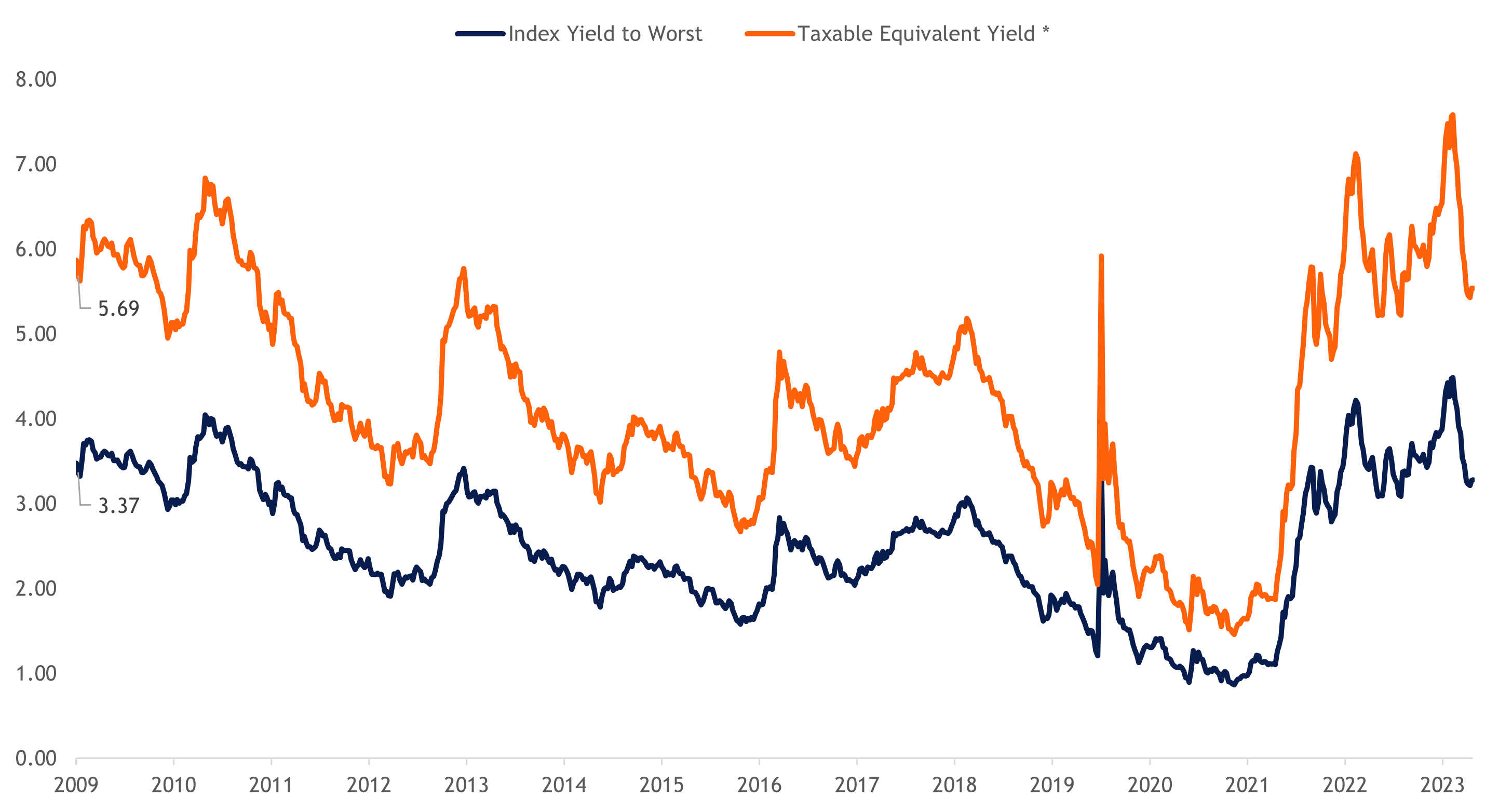
* Assumes tax rate of 40.8%
Source: LPL Research, Bloomberg 01/09/24
Disclosures: All indexes are unmanaged and cannot be invested into directly.
Past performance is no guarantee of future results.
While overall mutual fund demand was lackluster last year, continued separately managed account demand has kept high-quality munis at the front end of the curve well supported. As such, the recent steepening of the muni yield curve could provide attractive opportunities by moving out to longer maturities. AAA-rated municipals beyond the 10-year tenor are currently yielding more than U.S. Treasuries on a taxable-equivalent basis, with the spread between the two growing as you move further out the curve (note though that longer-maturity securities can experience greater mark-to-market volatility).
Fundamentals for the asset class are healthy as well as many municipalities continue to sit on ample rainy day and reserve funds. And though tax revenue collections are likely past peak levels, they remain healthy and above pre-pandemic trends. The wildcard in the short-term remains the supply and demand dynamics for the asset class. While 2024 issuance could continue the trend of lower net issuance, demand could accelerate as investors seek to take advantage of still-attractive yields by moving out of cash and other shorter-maturity investment strategies before the Federal Reserve starts to cut rates, which we think could happen this summer. With nominal yields above levels seen much of the past decade, still strong fundamentals, and perhaps an improving supply/demand dynamic, we think munis could be poised for another solid year in 2024.
IMPORTANT DISCLOSURES
This material is for general information only and is not intended to provide specific advice or recommendations for any individual. There is no assurance that the views or strategies discussed are suitable for all investors. To determine which investment(s) may be appropriate for you, please consult your financial professional prior to investing.
Investing involves risks including possible loss of principal. No investment strategy or risk management technique can guarantee return or eliminate risk.
Indexes are unmanaged and cannot be invested into directly. Index performance is not indicative of the performance of any investment and does not reflect fees, expenses, or sales charges. All performance referenced is historical and is no guarantee of future results.
This material was prepared by LPL Financial, LLC. All information is believed to be from reliable sources; however LPL Financial makes no representation as to its completeness or accuracy.
Unless otherwise stated LPL Financial and the third party persons and firms mentioned are not affiliates of each other and make no representation with respect to each other. Any company names noted herein are for educational purposes only and not an indication of trading intent or a solicitation of their products or services.
Asset Class Disclosures –
International investing involves special risks such as currency fluctuation and political instability and may not be suitable for all investors. These risks are often heightened for investments in emerging markets.
Bonds are subject to market and interest rate risk if sold prior to maturity.
Municipal bonds are subject and market and interest rate risk and potentially capital gains tax if sold prior to maturity. Interest income may be subject to the alternative minimum tax. Municipal bonds are federally tax-free but other state and local taxes may apply.
Preferred stock dividends are paid at the discretion of the issuing company. Preferred stocks are subject to interest rate and credit risk. They may be subject to a call features.
Alternative investments may not be suitable for all investors and involve special risks such as leveraging the investment, potential adverse market forces, regulatory changes and potentially illiquidity. The strategies employed in the management of alternative investments may accelerate the velocity of potential losses.
Mortgage backed securities are subject to credit, default, prepayment, extension, market and interest rate risk.
High yield/junk bonds (grade BB or below) are below investment grade securities, and are subject to higher interest rate, credit, and liquidity risks than those graded BBB and above. They generally should be part of a diversified portfolio for sophisticated investors.
Precious metal investing involves greater fluctuation and potential for losses.
The fast price swings of commodities will result in significant volatility in an investor's holdings.
Securities and advisory services offered through LPL Financial, a registered investment advisor and broker-dealer. MemberFINRA/SIPC.
Not Insured by FDIC/NCUA or Any Other Government Agency | Not Bank/Credit Union Deposits or Obligations | Not Bank/Credit Union Guaranteed | May Lose Value
For Public Use – Tracking: #526228
