


March and First Quarter Fund Flows
With additional content provided by Kent Cullinane, Analyst, Research.
With March and the first quarter (Q1) behind us, we conduct a deep dive into fund flows over the respective periods. Flows measure the net movement of cash into and out of investment vehicles, such as mutual funds and exchange-traded funds (ETF). We analyze flows to gain insight into investor demand and sentiment surrounding asset classes, sectors, and other classifications of markets.
Morningstar Category Flows
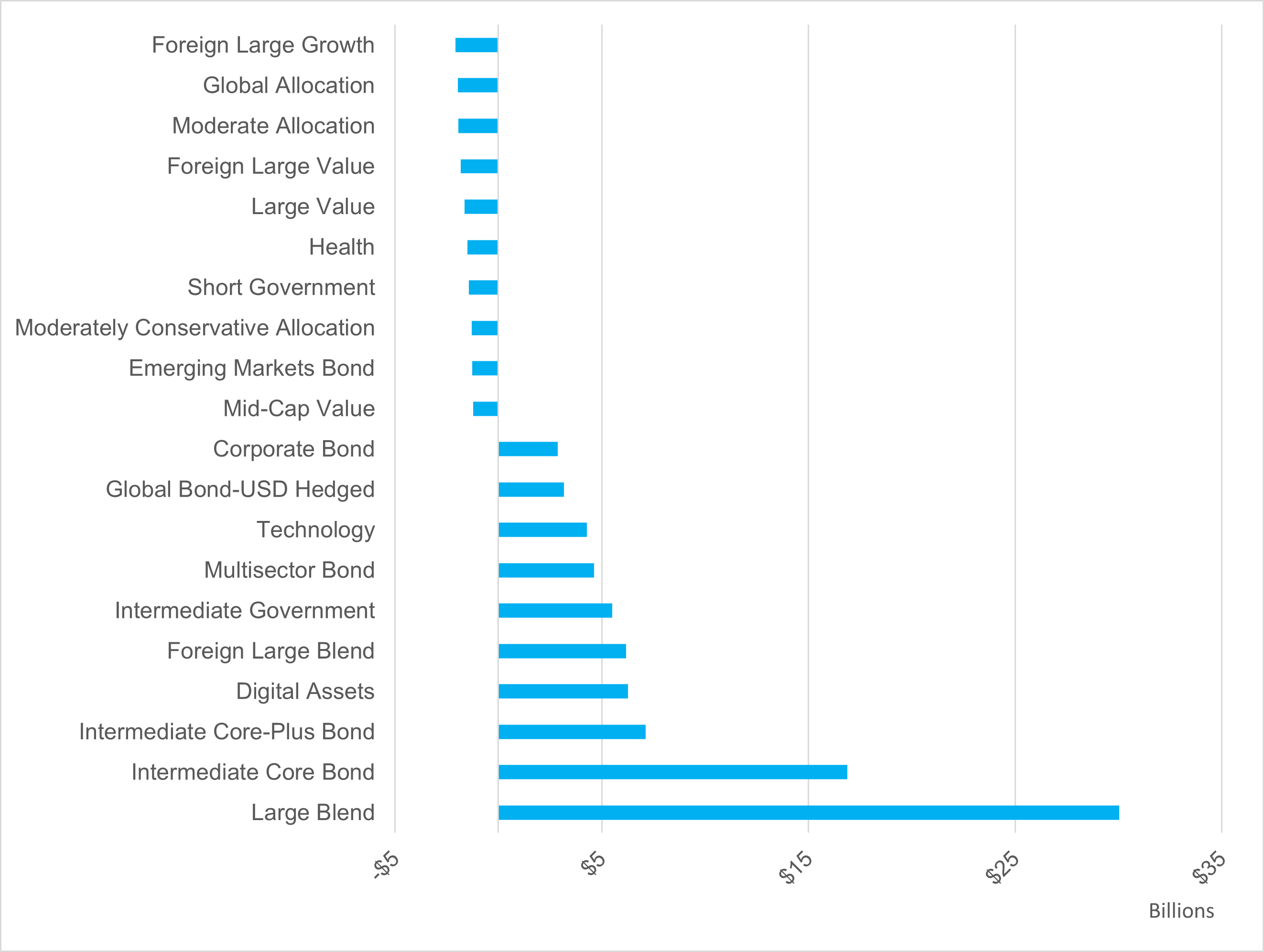
When looking at Morningstar category data in March, large blend equities experienced the largest inflow at around $30 billion, followed by intermediate core and intermediate core-plus bonds with inflows of $17 billion and $7 billion, respectively. Q1 flows mimic these monthly flows, with large blend equities narrowly beating intermediate core bonds year-to-date with both around $48 billion of inflows. Given the risk-reward trade-off in fixed income relative to equities, it’s easy to understand why investors continue to pile into bonds at a faster rate than equities, with six of the top 10 categories by inflows comprised of bonds during the trailing one-month and year-to-date periods. Another category with significant inflows was digital assets, with the category gaining over $6 billion over the month and almost $16 billion year to date. The meaningful inflow into this asset class is due to the Securities and Exchange Commission’s (SEC) approval of digital asset ETFs at the start of the year.
Looking at the other end of the spectrum, foreign large growth funds saw the largest outflow in March at $2 billion. Following foreign large growth were two allocation categories (global allocation and moderate allocation) and two value-style categories (foreign large value and (domestic) large value). As the monthly flows suggest, Q1 flows paint the same picture, with foreign large growth experiencing the largest outflow ($10 billion) year-to-date.
Investors Continue to Rotate into Core Bonds
Trailing 1-Month Net Asset Flows Top Ten and Bottom Ten Across Morningstar Categories (AUM, Billions $)
Source: LPL Research, Morningstar Direct, 04/19/24
Disclosures: Indexes are unmanaged and cannot be invested in directly. Past performance is no guarantee of future results.
Sector Flows
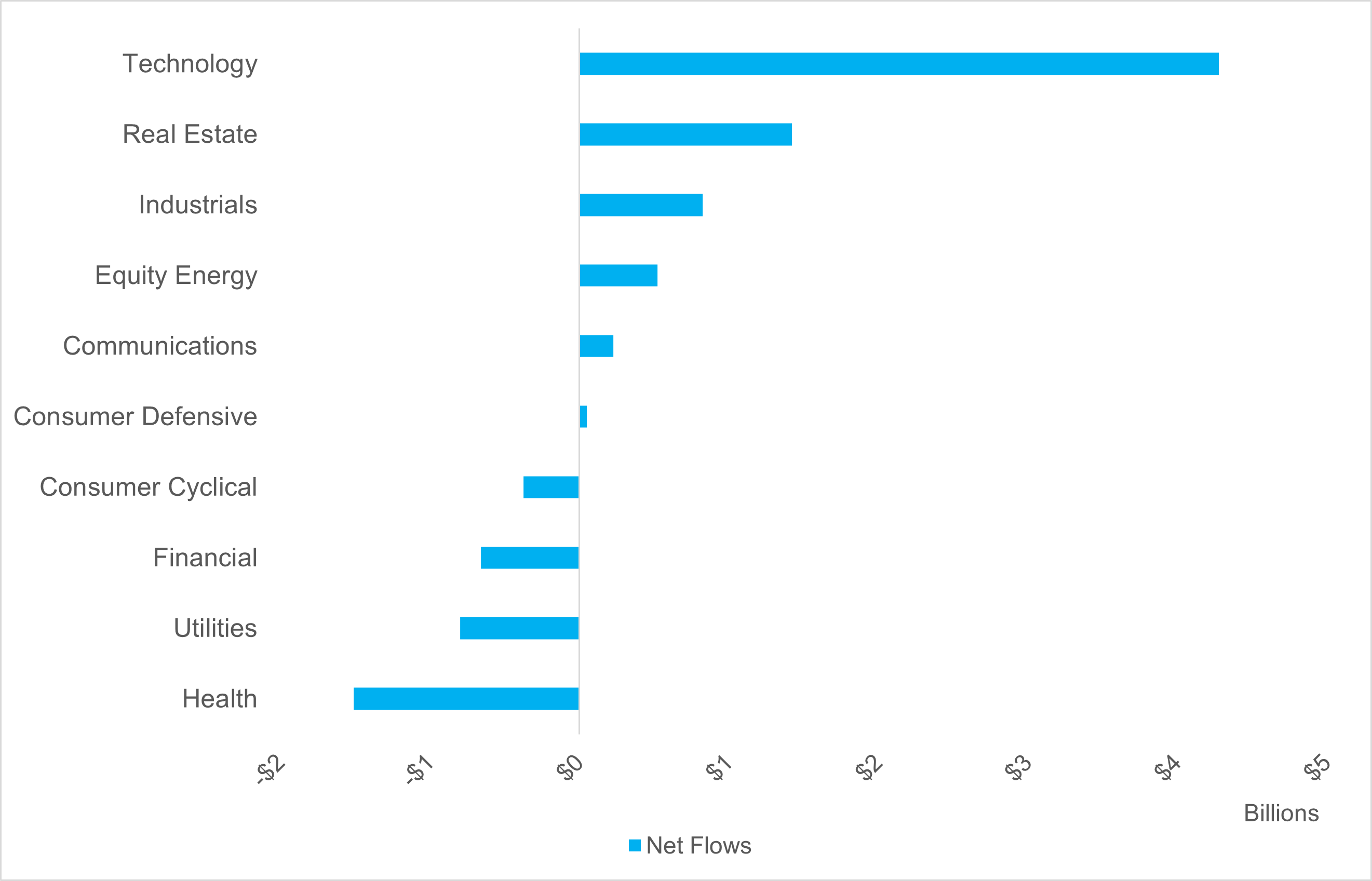
When looking at individual domestic equity sector data in March, the technology sector saw the largest inflow by a wide margin, gaining over $4 billion in assets over the month. Following technology were real estate, industrials, and energy. Year-to-date, technology continues to dominate flows, with the sector adding almost $13 billion in Q1. Given the run-up in the "Magnificent Seven" stocks, and more broadly U.S. growth equities, it’s no surprise to learn that technology is at the top of the list year-to-date.
Conversely, healthcare experienced the largest outflow in March at $1.5 billion. Following healthcare were utilities, financials, and consumer cyclicals all experiencing net outflows. Healthcare continues to struggle after a disappointing 2023 given a slowdown in medical device sales and a drop in COVID 19-related revenue. After this underwhelming 2023 and start to 2024, valuations in this sector are starting to appear attractive relative to history.
Technology Flows Outshine Other Sectors by a Significant Margin
Trailing 1-Month Net Asset Flows across Morningstar Sectors (AUM, $ Billions)
Source: LPL Research, Morningstar Direct, 04/19/24
Disclosures: Indexes are unmanaged and cannot be invested in directly. Past performance is no guarantee of future results.
There are similarities when comparing the latest LPL Research Strategic and Tactical Asset Allocation Committee (STAAC) tactical views with the March flows data. The top asset classes by inflows are large blend equities, intermediate core, and intermediate core-plus bonds. Until late March, STAAC favored large cap equities over small and mid (SMID) caps, as impressive earnings growth and favorable technicals outweighed their relatively steep valuations, at least until large caps started to run out of steam in recent weeks. The STAAC recently upgraded their perspective on SMID caps to neutral, sourced from large cap growth equities, given the pullback in large-growth equities, coupled with the relatively attractive valuations presented by SMID caps. The STAAC remains slightly overweight large cap growth equities, albeit at a slimmer margin, and neutral SMID caps.
From a sector perspective, tactically, the STAAC is neutral on the top sector by inflows, technology, as the market has rotated out of some of the artificial intelligence (AI)-driven winners and valuations have compressed, albeit marginally. While the STAAC’s perspective is neutral healthcare, the largest sector by outflows, the relative trend has been negative given the slowdown in COVID 19-related sales, patent expirations, policy pressure on drug prices and disappointing reimbursement rates for private Medicare plans.
In fixed income, the STAAC maintains a neutral duration perspective, favoring fixed income broadly over cash, as the risk-return trade-off is attractive relative to history.
IMPORTANT DISCLOSURES
This material is for general information only and is not intended to provide specific advice or recommendations for any individual. There is no assurance that the views or strategies discussed are suitable for all investors. To determine which investment(s) may be appropriate for you, please consult your financial professional prior to investing.
Investing involves risks including possible loss of principal. No investment strategy or risk management technique can guarantee return or eliminate risk.
Indexes are unmanaged and cannot be invested into directly. Index performance is not indicative of the performance of any investment and does not reflect fees, expenses, or sales charges. All performance referenced is historical and is no guarantee of future results.
This material was prepared by LPL Financial, LLC. All information is believed to be from reliable sources; however LPL Financial makes no representation as to its completeness or accuracy.
Unless otherwise stated LPL Financial and the third party persons and firms mentioned are not affiliates of each other and make no representation with respect to each other. Any company names noted herein are for educational purposes only and not an indication of trading intent or a solicitation of their products or services.
Asset Class Disclosures –
International investing involves special risks such as currency fluctuation and political instability and may not be suitable for all investors. These risks are often heightened for investments in emerging markets.
Bonds are subject to market and interest rate risk if sold prior to maturity.
Municipal bonds are subject and market and interest rate risk and potentially capital gains tax if sold prior to maturity. Interest income may be subject to the alternative minimum tax. Municipal bonds are federally tax-free but other state and local taxes may apply.
Preferred stock dividends are paid at the discretion of the issuing company. Preferred stocks are subject to interest rate and credit risk. They may be subject to a call features.
Alternative investments may not be suitable for all investors and involve special risks such as leveraging the investment, potential adverse market forces, regulatory changes and potentially illiquidity. The strategies employed in the management of alternative investments may accelerate the velocity of potential losses.
Mortgage backed securities are subject to credit, default, prepayment, extension, market and interest rate risk.
High yield/junk bonds (grade BB or below) are below investment grade securities, and are subject to higher interest rate, credit, and liquidity risks than those graded BBB and above. They generally should be part of a diversified portfolio for sophisticated investors.
Precious metal investing involves greater fluctuation and potential for losses.
The fast price swings of commodities will result in significant volatility in an investor's holdings.
Securities and advisory services offered through LPL Financial, a registered investment advisor and broker-dealer. MemberFINRA/SIPC.
Not Insured by FDIC/NCUA or Any Other Government Agency | Not Bank/Credit Union Deposits or Obligations | Not Bank/Credit Union Guaranteed | May Lose Value
For Public Use – Tracking: #569533