


Are “Magnificent Seven” Valuations Warranted?
Additional content provided by Kent Cullinane, Analyst, Research.
With Q4 2023 earnings season wrapping up, having nearly all the 500 S&P constituents reporting earnings, we review how the “Magnificent Seven” — comprised of Apple (AAPL), Amazon (AMZN), Alphabet (GOOG/L), Meta (META), Microsoft (MSFT), NVIDIA (NVDA), and Tesla (TSLA) — contributed to the broader S&P earnings this quarter and if their lofty valuations are still warranted.
Earnings from the “Magnificent Seven” were mostly positive this quarter, with all stocks but TSLA reporting results that exceeded expectations. For the second consecutive quarter, TSLA missed expectations, which led to their market cap briefly dipping below $600 billion. In contrast, every other component of the “Magnificent Seven” has a market cap of over $1 trillion, with AAPL and MSFT both hovering around $3 trillion. One of the biggest winners from Q4 earnings was NVDA, whose year-over-year earnings surged nearly 500%, as artificial intelligence (AI) continues to propel this semiconductor stock to new heights.
Impressive earnings from the “Super Six”, which is the “Magnificent Seven” minus TSLA, helped boost the blended year-over-year earnings growth rate for the S&P to 4.8%, which would mark the second consecutive quarter of positive year-over-year earnings growth. When looking at the “Super Six” contribution to the S&P’s earnings growth this quarter relative to the 494 remaining S&P constituents, it’s easy to understand why their performance has continued to drive equity markets higher.
Massive Earnings Contribution From “Super Six” in Q4
4Q 2023 Y/Y Earnings Growth (%) | Upside Surprise (%) | Contribution to 4Q 2023 S&P 500 EPS (ppt) | Consensus Estimated Earnings Growth in 2024 (%) | Revision to 2024 Consensus Estimate Since 01/15/24 (%) | |
NVIDIA (NVDA) | 495.9 | 12.7 | 2.3 | 18.4 | 41.2 |
Amazon (AMZN) | 3294.0 | 26.6 | 2. | 29.0 | 46.2 |
Meta (META) | 195.4 | 9.9 | 1.7 | 16.1 | 31.0 |
Alphabet (GOOG/L) | 49.8 | 3.1 | 1.4 | 1.5 | 17.5 |
Microsoft (MSFT) | 25.9 | 6.5 | 1.0 | 14.8 | 3.1 |
Apple (AAPL) | 12.6 | 3.8 | 0.8 | 8.9 | 0.4 |
| Total S&P 500 EPS Contribution From Super 6: | 9.3 | ||||
| S&P 500 Earnings Per Share Growth Overall* | 4.8 | ||||
| S&P 500 Earnings Per Share Growth Ex. Super Six | -4.5 | ||||
* Earnings season not fully completed with 488 S&P 500 companies having reported Q4 2023 results
Source: LPL Research, FactSet 02/29/24
Disclosures: Indexes are unmanaged and cannot be invested in directly. Past performance is no guarantee of future results. Any companies referenced are being presented as a proxy, not as a recommendation.
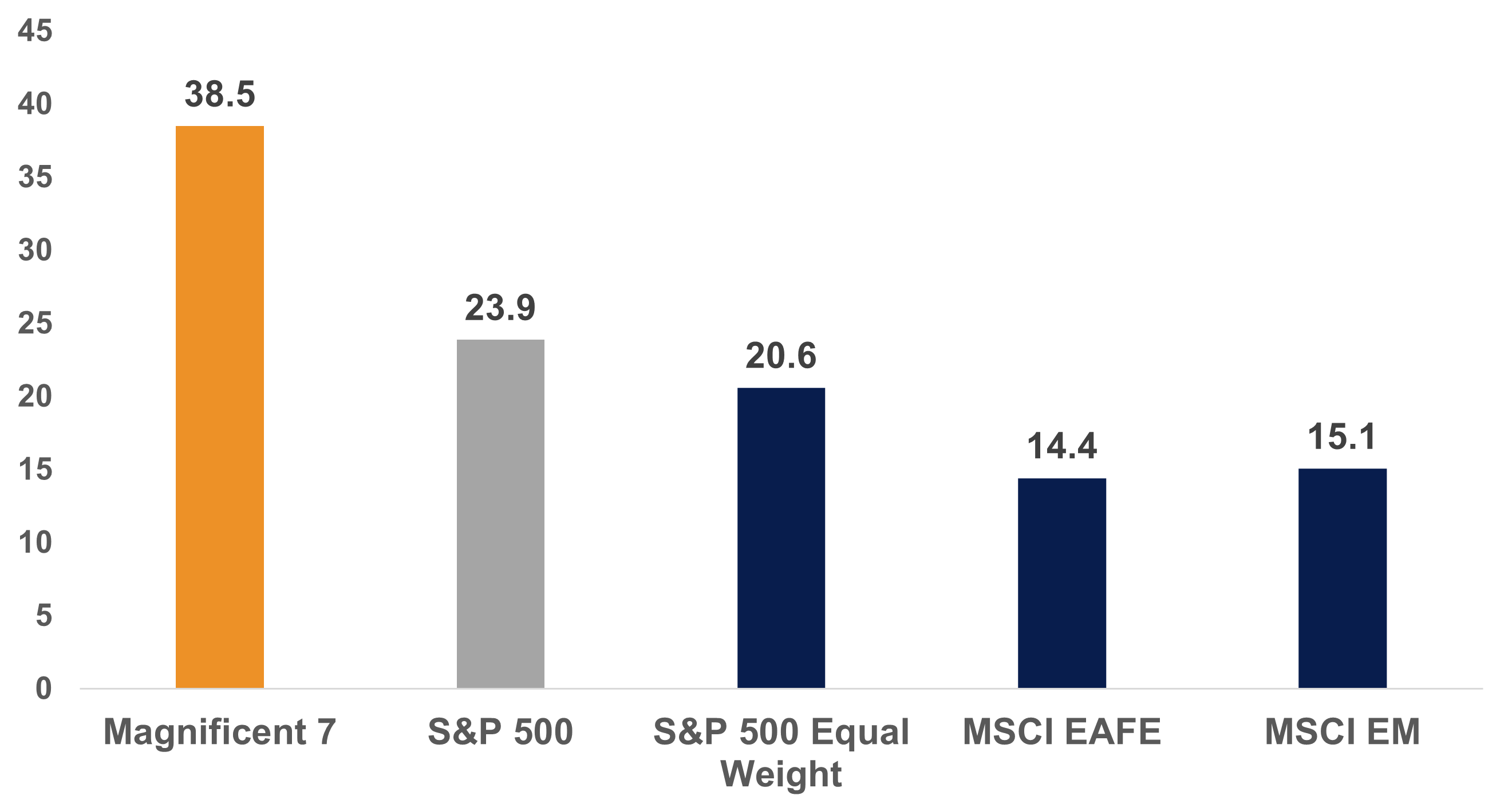
While earnings and performance have been remarkable, from a valuation perspective, these companies are trading at significant price-to-earnings (PE) multiples when compared to the rest of the market globally. The chart below highlights the aggregate PE ratio of the “Magnificent Seven” compared to other asset classes.
When Will “Magnificent Seven” Valuations Come Back Down to Earth?
"Magnificent Seven" PE ratio compared to other asset classes based on trailing 12-month earnings.
Source: LPL Research, Factset, 03/05/24
Disclosures: All indexes are unmanaged and can’t be invested in directly. Past performance is no guarantee of future results.
As noted in the “Magnificent Seven Valuations” chart, when compared to the S&P 500 equal-weight index, the “Magnificent Seven” is trading at nearly twice the PE multiple. We consider this rich even when considering the double-digit earnings growth this group is generating at a time when earnings for the rest of the market are down slightly. When looking abroad, the PE appears nearly three times larger than the MSCI EAFE Index and the MSCI emerging markets (EM) Index, though these markets may be value traps because of weakening earnings outlooks.
Given the growth characteristics of these companies in a year in which growth stocks have continued to outpace value stocks by a significant margin, it’s no surprise they have outperformed the broader market.
From an asset allocation perspective, the Strategic and Tactical Asset Allocation Committee (STAAC) favors the growth style amid better technical momentum and expected stabilization in interest rates as inflation likely continues its downtrend. The growth style, particularly technology-oriented companies, enjoyed a strong start to 2024 and should continue to benefit from an improved macroeconomic environment and superior earnings power, though valuations are elevated and the Committee is watching technicals closely for signs of a reversal.
IMPORTANT DISCLOSURES
This material is for general information only and is not intended to provide specific advice or recommendations for any individual. There is no assurance that the views or strategies discussed are suitable for all investors. To determine which investment(s) may be appropriate for you, please consult your financial professional prior to investing.
Investing involves risks including possible loss of principal. No investment strategy or risk management technique can guarantee return or eliminate risk.
Indexes are unmanaged and cannot be invested into directly. Index performance is not indicative of the performance of any investment and does not reflect fees, expenses, or sales charges. All performance referenced is historical and is no guarantee of future results.
This material was prepared by LPL Financial, LLC. All information is believed to be from reliable sources; however LPL Financial makes no representation as to its completeness or accuracy.
Unless otherwise stated LPL Financial and the third party persons and firms mentioned are not affiliates of each other and make no representation with respect to each other. Any company names noted herein are for educational purposes only and not an indication of trading intent or a solicitation of their products or services.
Asset Class Disclosures –
International investing involves special risks such as currency fluctuation and political instability and may not be suitable for all investors. These risks are often heightened for investments in emerging markets.
Bonds are subject to market and interest rate risk if sold prior to maturity.
Municipal bonds are subject and market and interest rate risk and potentially capital gains tax if sold prior to maturity. Interest income may be subject to the alternative minimum tax. Municipal bonds are federally tax-free but other state and local taxes may apply.
Preferred stock dividends are paid at the discretion of the issuing company. Preferred stocks are subject to interest rate and credit risk. They may be subject to a call features.
Alternative investments may not be suitable for all investors and involve special risks such as leveraging the investment, potential adverse market forces, regulatory changes and potentially illiquidity. The strategies employed in the management of alternative investments may accelerate the velocity of potential losses.
Mortgage backed securities are subject to credit, default, prepayment, extension, market and interest rate risk.
High yield/junk bonds (grade BB or below) are below investment grade securities, and are subject to higher interest rate, credit, and liquidity risks than those graded BBB and above. They generally should be part of a diversified portfolio for sophisticated investors.
Precious metal investing involves greater fluctuation and potential for losses.
The fast price swings of commodities will result in significant volatility in an investor's holdings.
Securities and advisory services offered through LPL Financial, a registered investment advisor and broker-dealer. MemberFINRA/SIPC.
Not Insured by FDIC/NCUA or Any Other Government Agency | Not Bank/Credit Union Deposits or Obligations | Not Bank/Credit Union Guaranteed | May Lose Value
For Public Use – Tracking: #549677