


Sector Returns During a Fed Pause
With additional content provided by Colby Hesson, Analyst.
Key Takeaways
- Long Federal Reserve (Fed) pauses have historically been fairly good environments for stocks. The current pause has reached 280 days — the second-longest in modern market history, trailing only the 2006–07 pause that reached 446 days.
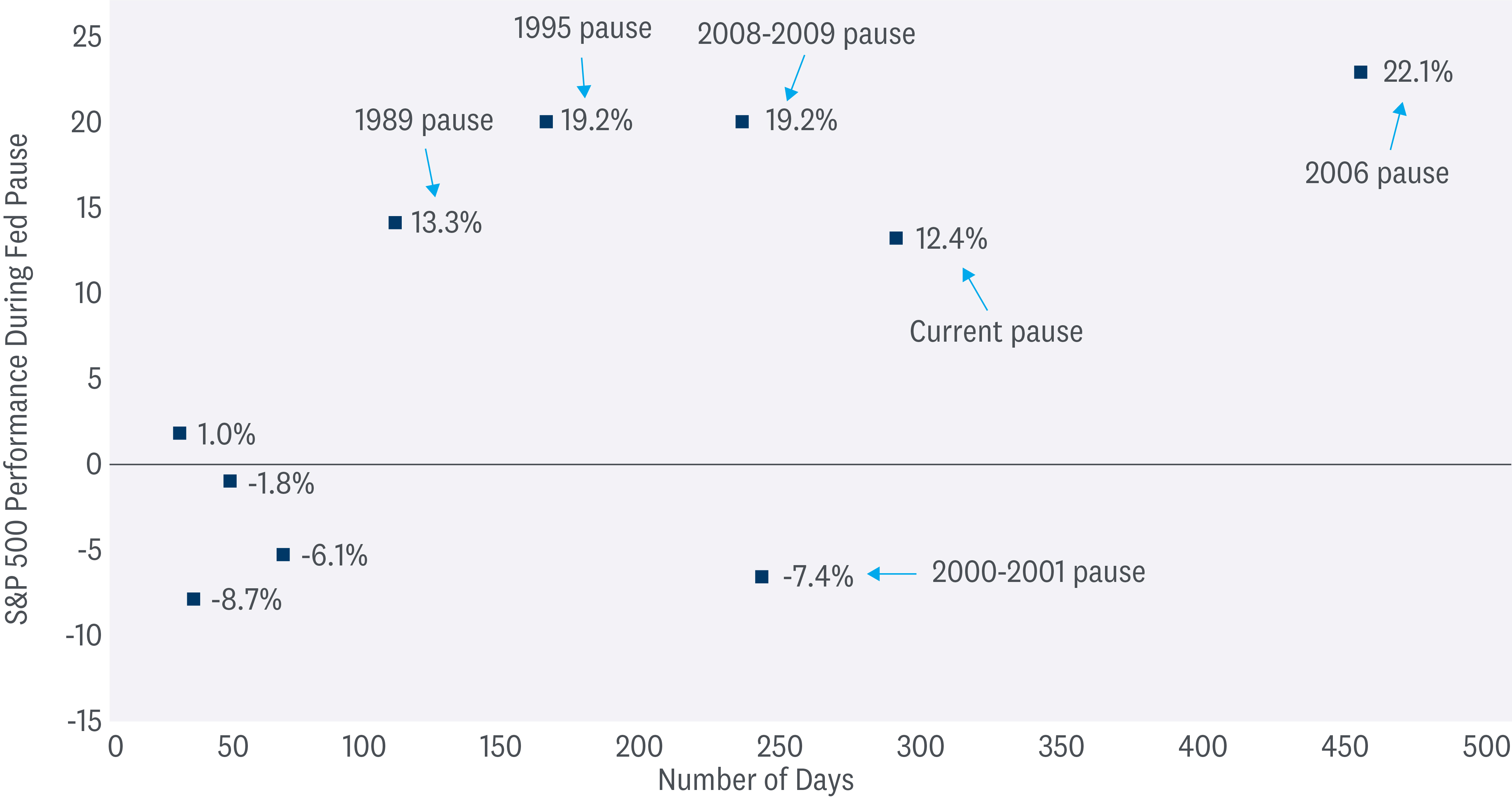
- Over the past 50 years, the S&P 500 has only gained 6% on average during pauses. But over the last six pauses going back to 1989, which have generally been longer, the average gain has been 13.1%. Long pauses are typically good for stocks.
- The financial and energy sectors are typically the top-performing sectors during long pauses and generally return over 15% during the period.
Long Pauses Have Historically Been Good for Stocks
Over the last 30 years, Fed pauses have generally been good for the stock market. But prior to 1989, stocks did not do so well when the Fed was on hold. We believe the primary difference between the pre-1989 Fed rate cycles and those that came after is their duration.
As we discussed in this week’sWeekly Market Commentary, the current pause has now reached 280 days — the second-longest in modern market history, trailing only the 2006–07 pause that reached 446 days. The average Fed pause has lasted 146 days.
Over the long term, covering 50 years and 10 pause periods, the S&P 500 has only gained 6% on average during an average of 160 days. But, pulling out just the last six pauses, which have been longer than the average pause (240-day average), the average gain has been about 13%. During the current pause — one of the longest — the S&P 500 is up 12.4% (as of May 1).
Bottom line:Long pauses are typically good for stocks, and the gains achieved since the Fed’s last hike in July 2023 are consistent with recent history. The pace and rise of the S&P 500 during that time are in line with what we are seeing now. It’s when the Fed is forced to cut because of economic weakness that stocks tend to sell off — not in the environment we’re in today.
Long Pauses Tend to Be Accompanied by Attractive Stock Market Gains
Source: LPL Research, Strategas, Bloomberg, 05/02/24
Disclosures: Indexes are unmanaged and cannot be invested in directly. Past performance is no guarantee of future results.
Examining these periods individually, the only rate pause that was longer than the current one was in 2006–2007, which lasted for 446 days and generated a gain of 22.1%. Excessive leverage in the banking system juiced those returns, as we now know in hindsight, and a hard landing followed, so that period may not be a good comparison.
The 2000–01 pause was the one long pause when stocks fell. The S&P 500 lost 7% during that pause that was marred by the recession and devastating accounting scandals. Clearly, we’re not in an environment like that now.
The 1995–1996 pause was similar to the current pause because it was long and took place during an economic soft landing. Eventually, the economy and markets overheated because of the unchecked optimism surrounding the tech bubble, but that was four years after the pause. Some of you may recall Fed Chairman Alan Greenspan’s famous “irrational exuberance” comment in 1996. (He was right, but the warning came four years early.) Further, the early phase of the internet buildout in the mid-1990s echoes the massive artificial intelligence investment going on today.
We don’t know if Fed Chair Jerome Powell and company will successfully engineer a soft landing, but after the April jobs report, it looks more likely than not. Goldilocks may have returned, and if so, the 19% gain for stocks during the mid-1990s might be useful as a guide and tell us stocks have some more near-term upside.
Sector Comparisons
It’s also interesting to note which stock market sectors worked best and didn’t work during these previous long-pause periods when the Fed was on hold.
First, focusing on 1995 as the best comparison, technology was by far the best performer during that pause as the internet was getting started. Tech is an outperformer during the current Fed pause but is nowhere near as strong as it was in the mid-1990s. Also note that the cyclical value sectors performed well, namely energy, financials, industrials, and materials. While LPL Research maintains a neutral perspective of financials, industrials, and materials, performance for these sectors recently has been good, and infrastructure investment remains a catalyst.
Here are some other observations from the last five pauses:
- Financials enjoyed the best average performance during the pauses, including market-leading performance during the 2000–2001 period. The sector is also one of the best performers during the current pause, with a more than 16% gain.
- Energy has been the second-best performer on average over the last five pauses, including a market-leading 43% rally during the 2006–2007 pause and in-line performance during the current pause. Energy, which remains a favored sector for LPL Research, may benefit from the ongoing pause, but the tight supply that drove oil higher in 2006 will not be repeated because of how much oil the U.S. produces today.
Sector Leaders and Laggards During Fed Pauses
2/1/95 - 7/6/95 | 5/16/00 - 1/3/01 | 6/29/06 - 9/18/07 | 12/19/18 - 8/1/19 | 7/23/23 - 5/1/24 | Average | |
Financials | 14.7% | 22.6% | 13.4% | 17.7% | 16.1% | 16.9% |
Energy | 13.7% | 1.2% | 43.2% | 5.4% | 12.0% | 15.1% |
Industrials | 14.8% | 3.0% | 25.2% | 17.1% | 12.2% | 14.4% |
Materials | 16.1% | -7.2% | 37.9% | 16.6% | 8.0% | 14.3% |
Communications | 4.2% | -24.0% | 40.7% | 19.3% | 30.6% | 14.2% |
Information Technology | 27.2% | -32.4% | 32.6% | 27.7% | 14.9% | 14.0% |
Consumer Staples | 12.1% | 19.1% | 19.6% | 15.5% | 3.2% | 13.9% |
Utilities | 3.4% | 18.7% | 31.5% | 12.9% | 1.3% | 13.6% |
S&P 500 | 19.2% | -7.4% | 22.1% | 19.2% | 12.4% | 13.1% |
Health Care | 8.3% | 14.8% | 21.5% | 7.0% | 4.5% | 11.2% |
Consumer Discretionary | 8.1% | -8.1% | 16.9% | 19.7% | 6.8% | 8.7% |
Real Estate | * | * | 13.6% | 17.3% | -6.2% | 8.2% |
*Values are before Real Estate became an official sector
Source: LPL Research, FactSet, Bloomberg 05/02/24
Disclosures: All indexes are unmanaged and cannot be invested in directly. Past performance is no guarantee of future results.
Summary
Long pauses have historically been pretty good environments for stocks, and we’re in one right now, even if it ends this summer (which is far from assured). It’s important to remember, however, that monetary policy is only one factor influencing markets. There are other key fundamental drivers such as the economy, earnings, and, in the long term, valuations.
LPL’s Strategic and Tactical Asset Allocation Committee (STAAC) maintains its neutral equity stance tactically. The improved economic and earnings outlook this year has kept the risk-reward trade-off for stocks and bonds well balanced, perhaps with a slight edge to bonds over stocks currently when looking out to year-end. Recent stubbornly high inflation readings likely delayed Fed rate cuts and may limit the upside to stock prices over the balance of the year, although two cuts may still come by year-end.
IMPORTANT DISCLOSURES
This material is for general information only and is not intended to provide specific advice or recommendations for any individual. There is no assurance that the views or strategies discussed are suitable for all investors. To determine which investment(s) may be appropriate for you, please consult your financial professional prior to investing.
Investing involves risks including possible loss of principal. No investment strategy or risk management technique can guarantee return or eliminate risk.
Indexes are unmanaged and cannot be invested into directly. Index performance is not indicative of the performance of any investment and does not reflect fees, expenses, or sales charges. All performance referenced is historical and is no guarantee of future results.
This material was prepared by LPL Financial, LLC. All information is believed to be from reliable sources; however LPL Financial makes no representation as to its completeness or accuracy.
Unless otherwise stated LPL Financial and the third party persons and firms mentioned are not affiliates of each other and make no representation with respect to each other. Any company names noted herein are for educational purposes only and not an indication of trading intent or a solicitation of their products or services.
Asset Class Disclosures –
International investing involves special risks such as currency fluctuation and political instability and may not be suitable for all investors. These risks are often heightened for investments in emerging markets.
Bonds are subject to market and interest rate risk if sold prior to maturity.
Municipal bonds are subject and market and interest rate risk and potentially capital gains tax if sold prior to maturity. Interest income may be subject to the alternative minimum tax. Municipal bonds are federally tax-free but other state and local taxes may apply.
Preferred stock dividends are paid at the discretion of the issuing company. Preferred stocks are subject to interest rate and credit risk. They may be subject to a call features.
Alternative investments may not be suitable for all investors and involve special risks such as leveraging the investment, potential adverse market forces, regulatory changes and potentially illiquidity. The strategies employed in the management of alternative investments may accelerate the velocity of potential losses.
Mortgage backed securities are subject to credit, default, prepayment, extension, market and interest rate risk.
High yield/junk bonds (grade BB or below) are below investment grade securities, and are subject to higher interest rate, credit, and liquidity risks than those graded BBB and above. They generally should be part of a diversified portfolio for sophisticated investors.
Precious metal investing involves greater fluctuation and potential for losses.
The fast price swings of commodities will result in significant volatility in an investor's holdings.
Securities and advisory services offered through LPL Financial, a registered investment advisor and broker-dealer. MemberFINRA/SIPC.
Not Insured by FDIC/NCUA or Any Other Government Agency | Not Bank/Credit Union Deposits or Obligations | Not Bank/Credit Union Guaranteed | May Lose Value
For Public Use – Tracking: #575882